Sunday, June 21, 2026

Father's Day 2026

 It's been such a nice Father's Day. 


Lolly took me out for sushi tonight and we'll probably watch something together for a while.


I have 6 kids...each of them are very different from the others.


It was delightful hearing from them today.


I've been reading "On Writing" by Stephen King, after taking in the audiobook years ago.


I'm hearing stories and taking away entirely new messages from them, than I did then. I don't even remember what I must have taken away from them on my first go around. 

Friday, February 24, 2023

Things I Don't Buy

Silver is cool, and there are lots of neat things to like about it.

Silver coins used to be the most common way for people to pay for things like groceries and clothes and housing. When you hold a circulated silver coin in your hand, you can see the wear from its history of people passing it one to another, from place to place, probably thousands of times. A coin that handling has left looking better instead of worse (always a matter of opinion) is called a Circulation Cameo.

Today, silver bullion coins come from all over the world in varying weights and with amazingly diverse designs.

You can collect Superheroes, Disney Characters, Star Wars Commemoratives, solid silver coins shaped like giant diamonds, and giant 5-ounce reproductions of the US Quarter, and these are all governmental offerings from different nations, so they also carry a face value in the country of their origin.

Privately-minted/created “silver rounds” and other collectibles like statuary, bars, and fidget toys also make a rich market for all kinds of collectors.

There are a few things I’d like to call out that I prefer not to buy.

First, I find silver rounds with any political figure on them generally distasteful. Naturally, this goes doubly for personalities that I don’t align with myself. I’m talking mainly about rounds featuring a recent former US President, but I also don’t care for queens and kings that are ever-present on coinage from the Commonwealth Countries like Australia and Canada.

I don’t buy Chinese silver. This is mostly because I don’t read any flavor of Chinese text so I have no idea what the words on the coin say, or even if it plainly says, “FAKE” in Chinese. Chinese coins that look close to an ounce are often actually 20 grams instead (with 31.1g/oz). This is not deceptive, 20g is closer to a common cultural standard there, like an ounce is here. Dating is also frequently complicated with older Chinese coins, but several other countries use unusual dating standards as well.

Many reproductions of desirable silver coins come from China and other Asian countries, and they are often passed off by sellers as real. This is particularly problematic on sites where sellers can set up their own stores like Ebay, Walmart.com, and Amazon.com. I avoid those.

I like to shop online at dealers that specialize in bullion and coins, and I also like to buy in-person at pawn shops, coin shops, and antique shops local to me. It’s always best when I can see things in person before I decide whether to take them home.

I’ve been seeing privately produced notes called Silverbacks and Goldbacks. They are made with silver and gold foil, and each note is marked with the weight of the metal that it supposedly contains. I don’t like these, because I think that they will not retain their nominal value. Even if the note does contain the claimed amount of gold or silver, how can the metals be retrieved and used? It would be very difficult to do, and it would take a lot of foil to gather a practically useable amount of metal for say, striking coins or coating a metallic surface.

I think I’ll write about the things that I do like to collect next!

Wednesday, February 22, 2023

Why I Like Silver

When I was about ten, my Dad gave me a 1 ounce silver round.


He told me a little bit about silver then, how the price is always moving around, and how it is used in lots of industrial processes, and how it's a soft metal, so when it goes in jewelry and coins that are meant to be handled, there's usually some other metal in there as well like copper.

Some time later, I think he followed the thumping noise to my room, to find me banging on that silver round with a claw hammer on the carpet of my bedroom. It was not perfectly round anymore, and though I don't remember what design had been on the face, I do remember that it was pretty messed up by all of the tools that I had tried on that soft, pure silver.

My poor shocked Dad took away the mangled slug and I never saw it again. Looking back, I'm just glad I didn't try that experiment on anything valuable or rare.

It took until after a divorce and a few other life lessons for me to start collecting silver a little more seriously. I hope that I'll have some of the little things I've collected for the rest of my life. But, the bulk of my collection is meant to be converted, at some point, into something better. Like possibly a house. Or maybe other metals. I don't know, but it works at least partially as a diversified savings account.

And, silver will generally keep up with inflation better than cash under your mattress. Silver was around $5.70/ounce around this time in 1987. Today, it's $21.85. I should have kept that ugly slug.

Sunday, January 26, 2020

Rivendell and Me

They talk about the difficulty of making the bed right in Basic Military Training. But they're called "hospital corners" for a reason, too.

I lived in an inpatient facility...a psychiatric youth hospital called Rivendell, twice. (You might recognize that place name from Tolkien. It's where the Fellowship of the Ring is convened in "Lord of the Rings", and where Frodo goes later to recover with the elves.) Today it's called Copper Hills Youth Center.

I also served in the Air Force, and the beds in Basic Training were not as good as the ones at Rivendell. They were also easier to make, and inspection was far less intense.

I often wondered what I had done that could be so serious, to put me in that youth hospital. I was told, going in the first time, that my ADD medication caused my heart to beat irregularly, and they wanted to supervise me there.

For some reason the doctors wanted my consent to stay there, and that's what I was told for them to get it. I don't think the other kids there were asked at all.

Then, in group sessions at Rivendell, I was told over and over that I was in denial, and I needed to come clean about the things I'd done. 

The unit I was in housed about thirty children. We ate all of our meals there, in the cafeteria. We went to our one large school class together there every day. We were dutifully searched by the staff any time we were exposed to our parents or visitors. We were let through large double doors with magnetic locks and key switches on the wall by the staff any time we went for a meal, or to class, or to see family, or really anywhere outside of the area with the rooms we lived in.

There was a "Pink Room", there at Rivendell. It had pink rubber walls and floor, and nothing else except a solid door and a video camera where one wall met the ceiling. It was reserved for the worst kids, in their worst times.

Actually there was one step worse than the Pink Room, and that was being strapped to your bed by the staff so they could wait out a bad episode. That never happened to me.

I did go to the Pink Room, once. I don't remember the details. I disagreed with a member of staff, and though I never shouted or misbehaved, they decided to send me in there anyway. It was humiliating for a "good kid" like me, who never had a reason to be tied down or sent to the Pink Room before.

Once another kid stole candy from me, and I reported it.

Staff took it up with him, and after being threatened with the Pink Room he lashed out, and did get strapped down. I regretted having told, and never reported on another kid there again. I felt horrible that it had gone that way.

There were daily inspections, and (at a minimum, if nobody got in trouble) weekly room searches at Rivendell. I quickly learned how to make the bed right, and make my things appear orderly so that they wouldn't all be on the floor after a search for contraband.

Like in prison, we weren't allowed to have money. The one piece of contraband I hid in my room was a $10 bill that was in the spine of my LDS scripture Bible. I liked having that little bit of money to myself, even though there was nowhere to spend it. Sometimes the staff would take us to the commissary and let us spend some of our account money. I only ever had a dollar or two in there.

At Rivendell, I met kids who were criminals. Most of them had hurt people, and after not cooperating with whatever was mandated, they were sent there.

I dug deep in those group therapy sessions. Obviously nobody was there for no reason. What horrible thing had I done?

My two stays at Rivendell both happened before I was caught shoplifting at 13.

Monday, September 29, 2014

Homer Simpson's Birthdate

It's not on Wikipedia (yet), but Homer Simpson's birthdate is May 12 1956, according to Simpsons Season 4, episode 16, called "Duffless."

Now you know.


UPDATE/This Just In:

In the same episode, Homer sings about his first beer, and using a fake ID to buy it. The name on the ID was Brian McGee and Brian's birthdate was August 2 1948, boosting Homer's purported age almost eight years.


Friday, September 19, 2014

Dear PBS Nova: Details Matter

My screen cap of this image is dated April of 2012, and I did in fact send an email to correct the Nova team. Never got a reply.

The image you see is from an episode of PBS' series Nova, and this show was about elements.


The problem is that they use a 1943 United States Cent to illustrate the use of copper. In 1943, the United States was at war, and copper was considered too valuable to the war effort to use in cents. So they made them out of steel. They even stick to a magnet.


People collected the unusual cents in huge quantities, and you can still get a steel cent in pretty good condition at any coin shop for less than a dollar. Steel in 1943, guys. Not copper. Better luck next time.

Thursday, July 10, 2014

"Well, if it's a crime to love one's country then I'm guilty..."

In reading news stories, I sometimes encounter stories where a bad thing happened, someone is charged with a crime, but (at least from the facts that are presented) the guilt of that person is far from clear.  Recent examples include the Georgia father whose son died after being left in a hot car all day (and the mother) and the teenage companion of a violent man who killed a police officer before being killed himself.  (Also once Josh Powell, but at this point he's clearly guilty of murdering his children regardless of what happened to his wife.)

I could spend some time discussing why these people may not be guilty of the crimes that they're charged with (or may soon be charged with), but that's not really my point.  My point is to criticize the common reaction that people have to these stories.  They look at the situations that these people were in and say, "I would never do that.  Therefore these people are clearly guilty."  People who say this are wrong.  In particular, the first part of that statement is wrong.

When I read those stories, I don't see the actions of monsters.  I see people who made little mistakes that got out of hand and led to huge consequences (or people who were just in the wrong place at the wrong time).  As a less controversial example, let me refer to a somewhat older case.

In 2002, a Springville family had an adopted daughter who, because of her background prior to adoption, was stealing things like food.  The family had sought the advice of a psychologist who suggested that when this daughter steals something they give her lots of it so that she could learn that she doesn't need to steal.  Then, one day she stole a drink, so they had her drink a lot of water.

The daughter died, and the parents were tried with murder.  In writing the last paragraph, the whole explanation felt rather lame, and jurors agreed, finding the mother guilty of murder (and acquitting the father so as to not leave their other children effectively orphans).  But the problem with that analysis is that we're looking at it with hindsight.  These were well-meaning, generally good people who had opened their home to a difficult child and were trying to help her overcome the challenges of her childhood.  While the parents had definitely taken the actions that led to the girl's death, the death was by many accounts an accident.  These aren't hardened criminals, they're people who made a mistake that had terrible consequences.

This is what people don't realize about crime.  They think, "I'm not a criminal," but they don't realize that a) they commit crimes every day (speeding, anyone?) and b) they're just one unfortunate accident away from looking just like Mark Hacking (a man who was all kinds of terrible, capping it off by killing his wife and disposing of her in a dumpster).

So, the next time you see someone who accidentally left their child in a car (if you've ever left something like a drink on top of your car, then you too could have left a child in the car), even if they've recently read some puzzling things on the internet (think of the story that your browsing history from the last week would tell) and spent the day sexting their underage girlfriends (seriously, this guy hit the jackpot in terms of having dirt for police to dig up), consider that maybe this is just a terrible accident buried under a lot of unfortunate coincidences.

And the next time you read about someone who looks like they deserve whatever the law can throw at them, take a moment and be grateful that you didn't get accused of a terrible crime today.

Friday, July 04, 2014

Antisocial Attitudes and Misanthropy

Today I went to a parade.  I was not happy about it.

I started off being really upset at all the people who had, starting more than 36 hours before the parade, blocked off space with chairs, canopies, and ropes, and left them sitting there.  Even at the start of the parade, an astonishing number of these "reserved" spaces were completely unoccupied and most of them had empty seats.  (My family sat next to the largest canopy I saw all day--I believe that one woman and her infant child came and sat under it, using one of the six camp chairs that had been left to hold the spot.)

So I was angry about the greed and waste and inconsiderateness of the whole thing, and I realized that I was projecting that on everyone I met.  At one point I was carrying an umbrella (to provide my family with some shade, since we aren't supposed to use the enormous, empty canopy that we're sitting next to) and I realized that I was hoping it would hit everyone and everything I passed.  In short, I was being misanthropic.

I also realized that this is similar to how I feel about other large gatherings of people.  In October I went to an SEC college football game.  I was really cranky about that too, and ultimately left at half time.  (Incidentally, the home team came back from a significant deficit to lose in overtime.  By all measures it was a fantastic game, as college football games go.)

But during the tailgate party I went to and the part of the game that I did attend, I saw that this was more than a chance to stand in the hot sun on a humid day and possibly watch a few minutes of actual playing take place.  It was a chance to interact with 100,000 other people who were all sharing this same experience of watching the game.  I wasn't enjoying that aspect of the event, but I could tell that most of the people around me were.

It turns out that, while I do okay at times and have generally been getting "better" (just last week I spent 3 solid workdays talking to a room full of people), I'm an introvert.  I don't get all excited about sharing my life and the various events in it with huge masses of people.

This is something I've encountered in a couple of articles written by what I think are some very introspective, neurotic people.  They both noted that some people just prefer to not be in a huge crowd, nor to be the center of attention.  We aren't sad being alone, and we don't need to be "saved" (as happens in so many movies).

(On the other hand, I went to only one football game while I was in college (the first time) at the prompting of a well-meaning friend who wanted to save me from my reclusive ways.  He met a girl at a tailgate party and made me sit next to her, and now I'm married to her.  So what do I know?)

(On the gripping hand, I only enjoyed that football game because I spent it talking to her instead of paying attention to the game, which my school's team won by a large margin.)

Thursday, June 12, 2014

Feedly's Stand Against Criminals

I wish to congratulate the newsreader service Feedly on not caving into their attackers, who are currently staging a second DDOS on the service in as many days.


I'm a Feedly user, and I'll gladly wait for them to sort out the issue internally, rather than paying the ransom demanded. Good on them.

Sunday, May 18, 2014

The Philosophical Uncanny Valley

The Uncanny Valley is the phenomenon where, as depictions of people become more life-like, they reach a point where they become really creepy.  It's a popular idea, and I've not heard any ideas that conclusively explain why we react worse to things that are almost-but-not-quite-like us than to things that are very different from us.

I have my own theory, which is that our ability to see things varies from object to object.  With things that we're familiar with, we are able to see in nuanced detail.  An example of this is the "all black people look alike" phenomenon.

This kind of selective myopia happens in other aspects of our lives.  I realized this a little while ago while thinking of a coworker of mine.  He's a fantastic guy who, in addition to his day job, is very active in his religion.  He does counseling, volunteer work, and has become our building's de facto chaplain (we don't have a lot of public prayers, but sometimes we eat together and he gives a blessing that is moving poetry).  He isn't aggressive about his beliefs or anything, but they are a part of all aspects of his life, down to his coffee mug.

My beliefs are, in many important ways, quite similar to his.  But they are also different in some meaningful and irreconcilable ways.  This got me to wonder what he thinks of his heretic neighbors.  Does he see the similarities, or the differences?  I don't know about him (we're not close enough that we would talk about this sort of thing), but there are a lot of other people like him who seem to only see the differences.

I think that we encounter this all the time.  We each have a philosophical uncanny valley.  This is where a belief is very similar to our own, but different enough that it's all we can see.  It happens with religions (which is why Christians and Muslims seem to hate each other, but not as much as Sunnis and Shiites).  And it happens with just about everything on the internet.

I bring this up so that we can be aware of this characteristic of ourselves.  Maybe we can learn that there is more to see in others than their otherness.

Thursday, May 15, 2014

Saturday, May 03, 2014

Printed Guns and other Unicorns

3D-Printed guns are becoming quite the bugaboo in the public consciousness. Since the primary medium of 3D printing is various plastics, I'm going to use 'printed gun' and 'plastic gun' interchangeably here.

My co-founder of this Forum, Eric, mentioned recently that he considered posting about printed guns, but decided not to because of the politics behind the issue. I wish to present some facts in context. I'll say nothing about "rights" or "what should happen" here. Maybe some other time though.

This post isn't about politics, it's about the rainbow-farting unicorn that we call a plastic gun.

A plastic gun has several problems that are managed nicely by metal in firearms.

For example, if you want your firearm to be a "repeating firearm", or one that can shoot more than one time in a row, you're going to need a system of ejecting spent cartridges and chambering new ones. ("Repeating" usually means the next round is loaded manually, like in a lever-action. "Semi-Automatic" would also be correct here, if the weapon ejects and loads a cartridge after firing automatically.)
Semi-Automatic Operation

The inside of a currently-firing cartridge is under extremely high pressure and heat. This is why brass is so important in modern ammunition. Brass has high enough temperature resistance that a brass cartridge won't melt and stick to the inside of the chamber. Every time your gun ejects a spent shell, it's also ejecting a great deal of heat. This heat ejection will usually prevent an occurrence called "cookoff", where the chamber is so hot that the propellant in the cartridge combusts from residual heat, instead of the fire from the primer being struck.

Cookoff is extremely dangerous, as it does indeed make guns fire when the trigger is not touched. It's a problem in some current military guns, and those should be best-of-breed.

From Wikipedia
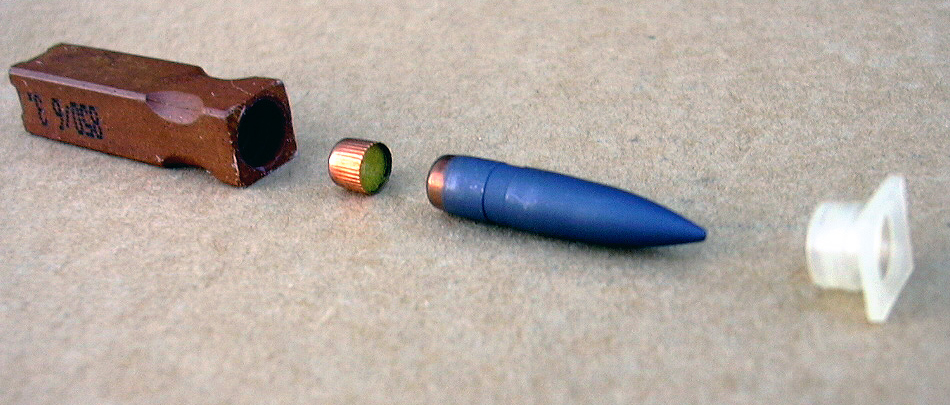
You may say at this point, "What about Caseless Ammunition?" Great question. First, the lack of a case means that the gun can't expel heat along with a spent shell. That's bad for plastic's structural integrity. Also, caseless ammunition still has a case, it just burns with the rest of the propellant when fired. But it isn't quite the same compound as the primary propellant in the cartridge body. It has to be shock-resistant and strong, so it's polymerized. These extra polymers burn when fired, and leave yet more fouling behind than a cased round does. Oh, and see that primer in the picture? Brass.

While we're here, let's talk about fouling. When you fire a typical small arm, hot gases and smoke are generated. When hot gases and smoke aren't hot anymore, they're just gunk that builds up a little more every single time you fire the gun. There is also typically a small amount of propellant--it's called smokeless powder in modern firearms, but it's really just less smoky and has a bigger punch than black powder--that doesn't ignite when the cartridge is fired. The low end is around 1% of the available propellant unburned after firing. I've seen much higher, especially in the case of guns that fire rounds that were originally designed for longer barrels. (For example, a revolver firing .22 caliber long rifle rounds.) If the bullet is pushed out the front of the barrel before some powder ignites, then the enormous heat and pressure stored in the gun's barrel quickly drops and the powder doesn't burn, instead becoming fouling on the inside of the gun.

These three concepts; Hot moving parts, the incredible heat and pressure inside the barrel and chamber, and
fouling, are the main issues with building a fully-realized "plastic gun."

The first problem is containing the explosion that you create when you fire a round. That's what the chamber and barrel do in a typical metal gun. Most plastics have nothing approaching the tensile strength of steel, and even when they come close, they'll still melt under heat and pressure. In other words, it's hard to make a plastic barrel that won't explode and hurt you. (And even well-made metal guns sometimes blow up and hurt the shooter during use. Google Kaboom and you'll see what I mean.)

And plastic's structural integrity isn't the only problem. Plastic also creates residue and smoke when heated, so this introduces yet another source of fouling.

Some guns are highly resistant to fouling-related problems, like the famously reliable AK-47. Many guns need cleaning after each trip to the range, and many of those will misfire at the range due to fouling from just a few fired rounds. And these are well-built metal guns. That's why I could break-down, clean, and reassemble my .22 rifles in my sleep. I've had to clean them a lot because they don't shoot reliably when dirty.

I'm not a materials science graduate. If you are, and you want to make a real plastic gun, here are some problems that need fixing:

  • A non-metal barrel that is strong under heat, can take repeated cycles without failing, and won't produce fouling of its own. (Perhaps carbon.)
  • The barrel must also hold shape internally so that the riflings aren't worn away. Without the riflings on the inside of the barrel, the bullet won't spin and fly straight.
  • If it is a repeating firearm, cookoff must be prevented, as it is extremely dangerous. The presence of multiple rounds inside the gun and possible inadequate heat management means cookoff is possible, and will have to be designed around. 
  • Ammunition with a non-metal case, that won't introduce more fouling.
  • Bonus Point: Did you remember the primer? It's the explosive cap at the end of the round that the firing pin hits. They're nearly always made of steel or brass. It shouldn't be a weaker material, because if the pressure in the cartridge causes it to melt or burst, you've got energy (and gunk) moving the wrong direction inside your gun. And that will lead to further fouling. Remember, a primer has to be strong enough not to explode from being dropped on the ground or careless handling, but weak enough to consistently fire by firing pin. 
  • And if the primer needs to be hard, so does the firing pin. Firing pins, again, are almost always made of steel in modern guns. 

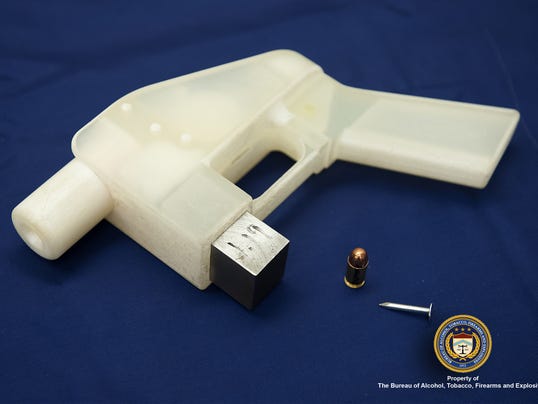
I saw the video of the 9mm plastic handgun, too. But remember, they still needed a metal firing pin for that gun, and the 9mm round inside was a standard, metal-cased round with a normal metal primer. And they could only shoot it once.

It's not undetectable to a metal detector as a "plastic gun" would presumably be, it's likely to blow up and hurt you on first use, and anyone with a modern conventional gun will have an enormous advantage.

I've seen barrels made of carbon, which has very good heat resistance, but tends to be fragile. Maybe a handgun could be printed with polymerized carbon?

Who knows. But for now, there's no such thing as a plastic gun in the true sense. This guy seems to have got closer to it than anyone else, but never produced a working model.

Wednesday, April 30, 2014

"Behold, the power plant of the future, today!"

I read an interesting column today about the future of 3D printing.  The author gave the caveat, "I don't fully understand them, so they seem like magic sent to us from the future by Captain Picard."  Which probably explains why, while she pointed out some of the many awesome things that 3D printing could do, she may be overselling them a bit, and her predictions for where things will go are, at best, a little naive.

For my own part, I'm largely unfamiliar with the technologies of 3D printers.  I've heard some reports of things that they've done, and last year I got to visit two different R&D labs that were exploring the capabilities of the technology.  The first was at NASA's Marshall Space Flight Center (probably the same group of people responsible for this).  The second, a couple of months later, was at Gulfstream's Savannah facility (probably related to this educational program, but definitely not the same place).  I got to see, first hand, some of the remarkable things that they could do (my favorite: a chess set with rooks that had a spiral staircase going up inside them).  3D printing allows for some amazing things that are simply not possible with other manufacturing techniques.

It's also got a lot of potential as a cost-effective way to do single-item or other low-quantity manufacturing.  This is normally touted as a way to go about prototyping.  But in my professional environment (buying parts for old systems that require from a few replacements a year to one every few years), this could be a silver bullet against obsolescence (or at least it can be once we redesign everything for the technology).  3D printing is a big deal.

Ms. Kohn hits on a number of major accomplishments of 3D printing.  The biggest, arguably, is the ability to print body parts.  This is about the closest that we've come to being able to play god, and if the technology can mature sufficiently, it could provide an ethical alternative to the old idea of cloning yourself to create a spare part factory (an idea that was only floated around to show some of the morally reprehensible applications of human cloning).

Her other ideas are interesting, but basically non-starters.  Sure, you can print houses, food, and toothbrushes.  But most people never would, because it would be a pointless waste of money.

Think of your traditional printer.  It gives you the technology to publish your own books.  But does Amazon give you a file that sends the book you just bought to your printer?  No!  It's far cheaper to mass produce those things, store them in warehouses, move them around, and deliver them to your door than it is to buy the paper and toner for your inkjet.  Desktop publishing is fantastic, but for anything more than a few copies or a few pages, it's far too expensive.

3D printing has the same problem.  Even if the 3D equivalent of "ink cartridges" go way down in price (like 2D ink never has done), it's still going to be far more expensive than just producing most of these things the old-fashioned way.

With any luck, 3D printing will be a significant part of the future.  And it will solve a lot of problems.  But it won't solve all of them.

Tuesday, April 29, 2014

Plato's Cave Lovingly Rendered in NES Zelda (and others!)

Shockingly good. Lots of good theoretical explanation, plus Zelda!

(Less than three minutes.)


(EDIT: Hat tip to Animal New York.)

Wednesday, March 05, 2014

Blocking a Sender in Gmail (2014)

Every now and then a person must deal with an acquaintance or family member who is sick and no longer communicates properly. Alternately, you may be in a dark place yourself. In either case, you may find email from certain parties to be inflammatory.

Recently a friend of mine complained about emails from a certain party, and mentioned that he hadn't figured out how to make them disappear from his Gmail properly.

I went into Gmail's settings and figured out what I think his solution would be.

This walkthrough will quickly demonstrate how to:

  • Create a Filter (or rule) in Gmail
  • Make emails from a known sender never appear in your inbox
  • And never give you a notification of it
  • And make it go away forever (you will not be aware that you were emailed!)
  • And not tip off the sending party that their messages are going in a black hole

Here we go. Start your engines and sign into your Google Accounts.

If you go to your main Gmail page in a desktop browser, you should see a gear below your user name in the upper right-hand corner of the screen.


Click the Gear icon, and then Settings in the drop-down box. You should now see the tabbed Settings page of your Gmail account.

Choose the Filters tab.


Conceptually, Gmail filters do two things;

  1. Match this kind of email
  2. Do this thing to it

With these two very basic tools in hand, we can do a lot of complex things. In this case, all we're doing is feeding the matching query the email address that needs blocking, and disappearing the (future) emails from there.

You can choose your own settings based on need. The settings shown here will make emails from the set party simply disappear, though you can make your rule send them to a folder for later perusal. This may be prudent if you have legal arrangements with the party and have to keep the emails even if you don't read them. Remember that the settings shown here will make you completely unaware that an email came from the sender in question!

After you get to the Filters tab, scroll all the way to the bottom (if you already have filters set up, it could be a long list) and click the text that says Create a new filter.


As you can see, we don't need much here. If all you want to do is block one sender, then all you need is that sender's address. In step one above, we've identified the sender we want to block.

Step two, the 'Do this thing to it', is below.


You'll note that I have checked above, Skip the Inbox (Archive it), then Mark as read, and then Delete it.

I'm probably doing more than I have to here. I want to make sure I don't get a notification in the middle of the night from Zaphod, so I'm making the Inbox completely ignore the email even though it's getting deleted.

Create your filter, and no more sleepless nights. Hope this helps.

Thursday, May 13, 2010

Still Alive - PORTAL IS FREE

I could litter this post with cake and companion cube jokes, but let's just get right to the meat of it...

Portal is free, for a few days. If you don't already own a copy, GET IT NOW. Heck, even if you do already own one, it wouldn't hurt to have a...uh...second Steam account? With your second copy of Portal in it!

It's OK. You'll feel good about this. Click the button and get the game. Even if you're not sure that you'll ever, ever play it. Just get it. It's free.

Get Portal. There is no good reason not to.

Tuesday, May 12, 2009

The Office, Pitch-Perfect

Please check out the excellent fan-written script for an episode of The Office, by Matthew Baldwin, the Defective Yeti himself.

If you're not already an Office fan, you might have trouble putting the right voices to the right people. But it's still funny.

Friday, September 19, 2008

Lan Party Time! Again! At Last!

So, yeah, I decided it's way past time for another LAN party. By my estimation, there wasn't one for all of '07, so we're way past due.

So here are the details for this year's LAN party:
Where: the Walker Residence, in Kaysville Utah. If you're invited, I'll send an address and a link to google maps. Any further info, you can contact me.

When: October 17th, 2008, we will start at 5:00, and the party will last into the night (my estimation is 11:00 or later, I will update this post as details become available.)

Who:
*Jake Wilcox
*Jeff Wilcox
*Andy Walker
*Krys Johnson
*Mark Wilcox
*Aaron Sitzman
*Julianne Wilcox
*Cody Walker
*Kyle Heath

EDIT: I've taken out our non-RSVPs and put them at the bottom of this post. I wanted to make the main list neat, but retain a list of those who couldn't make it this time for the sake of future parties.

Kyle Heath has also been added to the list. 15 Oct 1:00pm -Jake.

I updated the list last night. The people with asterisks by their names have RSVP'd, and I've removed the people who have RSVP'd that they won't be there. That's eight by my count.

IF YOU ARE NOT ON THIS LIST, YOU MAY NOT COME TO THIS PARTY. IF YOU FEEL THAT IT IS AN OVERSIGHT THAT YOU ARE NOT ON THIS LIST, YOU MUST CONTACT ME (JEFF).

Why: Because it's been too long.

What: Huh?

So, yeah, if you're on the list, you'll be receiving an email telling you that you're invited and requesting an RSVP.

There will be a cover charge, as the plan for this party is to have Garcia's cater again. I like Garcia's, and I've heard no complaints about them from fellow party goers in years past, so if you have a problem with it, you can go stick your head in a pig. The plan right now is to make the cover $15. It will almost certainly not go up from there, and it may go down. Again, keep an eye on this post as the most up to date details will be here.

This is what you should bring with you: Your computer, as we don't have enough spares to go around; a power strip, since everyone will need multiple places to plug in; network cables, so that your computer can talk to ours; A switch if you have one (a discount is being considered for those who bring one); headphones, if you want sound.

Expect to have one meal at the party, and a good time. Specific instructions for invitees will be sent via email.

Non-attendees:

Eric Widdison
Leon Walker
Gary Walker
Stan Wilcox
Eric Degroot
Sterling Canfield
Scott Barber

Tuesday, November 27, 2007

2007 Abravanel Hall Messiah Sing-In Critique

I attended Saturday the 24th's Messiah Sing-In. Every year my wife and I bring along some family and friends (this year we numbered sixteen strong), and we always like to discuss what we like or don't like about that year's performance.

I've decided to post my thoughts this year, and I'll do some catching up on previous years along the way.

Here is this year's dramatis personae:

Susanne Sheston - Chorus Master
Shannon Kessler - Soprano
Erica Brookhyser - Mezzo-Soprano (Soloing the Alto parts)
Tanner Knight - Tenor
Chad Sloan - Baritone (Soloing Baritone and Bass parts)

Again, the annual Abravanel Sing-In is tradition for us, so we're quite familiar with Susanne Sheston by this point. She's usually energetic, and she likes to share a little trivia about Messiah every year before the performance. One year (was it 2006 or 2005?) she was feeling particularly talkative and held forth on the history behind the tradition of standing for the Hallelujah Chorus. When she finished up the explanation after five minutes or so, the audience had a fun, 'What was that?' moment.

In general, she seems a good Chorus Master, and her rapport with the Utah Symphony Chorus is clear. In truth, it's the professional chorus' job to keep the lay chorus sounding passable, and that's always been done well under Susanne's leadership.

Her results in conducting the symphony are more mixed though. In 2005, she just couldn't keep the strings together at all. For nearly the duration of the concert, they were all over the place. This was improved hugely in the 2006 concert, leading me to believe that the buffoonery was not missed, and they aimed to do right after missing the mark so badly the previous year.

This year the strings again had some discord in a couple of places, but overall they held together well. If 2005 rated at a 3/10 and 2006 a 9/10, then they turned in a mid eight this year. Quite passable, but still room for improvement.

My one real complaint with Susanne as a conductor is that every year, she allows the symphony to blow through the transition between the solo and choral portions of "O thou that tellest good tidings to Zion." It's undoubtedly technically correct for her to do so, as the transition is written as quick and smooth. But Handel didn't know about Sing-Ins, and a lay chorus is unlikely to stand and sing without being directed to do so because of social pressure. This bungled transition is awkward and embarrassing for the audience members, but Susanne doesn't notice, because she's too busy directing the symphony and professional chorus, with her back turned to the audience.

I know that the idea must feel unnatural to her, but I hope that Susanne will resolve to pause the symphony, raise the audience, and then start the choral portion, as doing so will dispense with the most flustering moment of the performance for the people who paid for tickets.

Let's move on to soloists.

I'll not beat around the bush here. By far, the standout performance was commandingly delivered by Chad Sloan. He started strong, appropriately booming the introductory line of "Thus saith the Lord," and he continued to deliver rich, powerful reports for the rest of the performance. Chad ably, and, by the look of it, easily stole the show from his fellow performers.

Of special note was his performance of "The trumpet shall sound," in which his accompanying trumpeter was also well into a high-performance groove (with little-to-no warm up at that point). Both Chad and the trumpeter (I wish his name was listed in the program) ornamented sparingly but in brilliant fashion. Saturday night's performance of "The trumpet shall sound" was easily the best I've ever heard in person. The one small flaw in that piece was that in the second-to-last melisma (...this mortal must put on immortality), Chad finished his run a little more than a beat early, leaving the symphony to catch up. Notwithstanding that, it was superbly performed, and I'm glad that I was there to hear it.

I'm usually most critical of the Mezzo-Soprano and Alto parts of Messiah, as they put the singer in a range that gives her voice an unfortunate tone to my hearing. Anyone who's heard the 1996 Messiah album conducted by Sir David Willcocks and performed by The Mormon Tabernacle Choir will know this kind of Alto; strained, airy, and unfortunately, often sounding much like a lazy hen. (I'm aware that in the above-mentioned case, the offender was actually Paul Esswood, a man, and a counter-tenor, but the result is too-often effectively the same.)

The standard slaughter of the Alto arias (and recitatives, but I'm lumping them together here) is why I was surprised by Erica Brookhyser, the Mezzo-Soprano, who gave the remainder of the remarkable solo performances of the evening. Erica's voice has a rich, warm quality that suits emotional pieces, like "He was despised," uncommonly well.

Sometimes, with the Messiah performance effectively kicking off the holiday season, the soloists forget the somber nature of parts of Messiah. The two stand-alone Alto parts included in the Sing-In are prophetic (Behold, a virgin shall conceive) and mournful (He was despised). In each case, Erica took the stage with proper decorum and delivered deep, soulful performances.

Indeed, the second (in order of prominence) standout piece of the evening was her "He was despised." Erica brought it to an emotional climax that had me riveted.

Sadly, the other female soloist, Soprano Shannon Kessler, didn't fare nearly so well.

Shannon gave "Rejoice greatly, O daughter of Zion" a thorough butchering. This piece is full of melismas, during which she frequently missed notes or simply dropped the middle or end portions. She liberally ornamented--poorly, and far over-emphasized the "shout" portions of the piece, blowing them out and frequently sharping her triplet end notes in the process.

The soprano portions of Messiah are in my opinion, some of the more beautiful soprano parts around, especially from "There were shepherds abiding" through to "Glory to God." These were treated in a casual, blasé manner which did not do them justice.

Tanner Knight, the Tenor for the evening, seemed skilled enough for his class, but ultimately green. He also blew melismas, though not as badly or as frequently as Shannon did.

Tanner's main issue was consistency. For instance, he couldn't decide if "pardon'd" had two syllables or three, and it made his delivery feel off-kilter. His issues made him seem inexperienced rather than unskilled. I've no doubt that consistency will come to him with more performances under his belt.

It seemed that Tanner and Shannon were both given 'Come to Jesus' talks during intermission, as they each toned down their foibles for the second half. (I prefer this idea over the possibility that it took them each half the performance just to warm up.)

Keep in mind that in order to criticize well, one must be critical. Overall, the performance was very good, with some superb talent brought to bear by two of the soloists, which helped offset the talent that was perhaps uncharacteristically absent in the other two. The Utah Symphony Chorus backed the audience during the choral portions admirably. The symphony was in tune and on tempo in all except two short cases, and the First Trumpet made a simply extraordinary showing in the latter half.

It was a good year. I'm sorry it's over, and that I'll have to wait another year to go again.

Thursday, November 22, 2007

Kids Prompt the Damnedest Queries

Like this one: chip's combination cloud moon star +dvd "beauty and the beast"

If you have the Beauty and the Beast Special Edition DVD, then you can use the above query to find all of the needed answers to get through the interactive game on the disc and appease your kids.

Thank you, Google.